
Already a subscriber? Activate your premium account
Already a subscriber? Activate your premium account
PotatoWorld magazine, Now available separately.

Although costly, time-consuming, and laborious, mulching has been widely implemented in crop production throughout the world since ancient times. Mulching can be done using organic matter (such as straw, leaves, haulm), or film of black, white, or transparent polyethylene. Recently, the body of literature on the benefits of mulching in potato cultivation is growing rapidly. The benefits of making the hydrothermal conditions in the topsoil more conducive to the potato crop and thereby making the crop more climate-robust, as well as the benefits of nutrient cycling, improved physical, chemical, and biological soil fertility, and improved abiotic and biotic microenvironments aboveground are becoming increasingly important in modern, sustainable potato production.
The most important positive effects of mulch relate to physical soil fertility. Such effects include improving soil structure, enhancing soil temperature early in the growing season, keeping the soil (and thereby the tubers) cool later in the crop cycle (especially during dry spells), enhancing water infiltration and retaining soil moisture (thus increasing water use efficiency), and protecting the soil against heavy rains.
Organic mulch also impacts chemical soil fertility by contributing plant nutrients to the soil, which directly or indirectly supports the nutrient uptake by crops, and has a positive effect on nutrient cycling by stimulating the soil microbiome. The long-term effect of organic mulch on soil pH is usually minimal.
Mulching enhances biological soil fertility and soil health through its positive effect on the diversity of soil microorganisms and by boosting microbial activity. Mulching might even partly control soil-borne pests and diseases, probably through its impact on microbial diversity and bacterial and fungal network structures of the soil microbiome, but also by stimulating the soil micro- and mesofauna.
Mulching also affects the aboveground ecology of the potato crop. It helps control weeds and deter aphids and other vectors of pathogens, such as viruses. The latter is especially important for Potato Virus Y. In contrast, there are also reports suggesting that mulch enhances oviposition of some vectors, such as planthoppers transmitting phytoplasmas. However, also in these cases, research demonstrated that mulching reduced disease severity, probably by enhancing disease tolerance. Mulch also provides safe shelter for beneficial insects and even attracts natural enemies of major pests. Mulch helps protect the tubers against late blight infection as it acts as a physical barrier, (partly) preventing spores from infested foliage from being washed into the soil during rain. But mulching can also increase foliar humidity and therefore prolong the leaf wetness duration, thus facilitating late-blight infection.
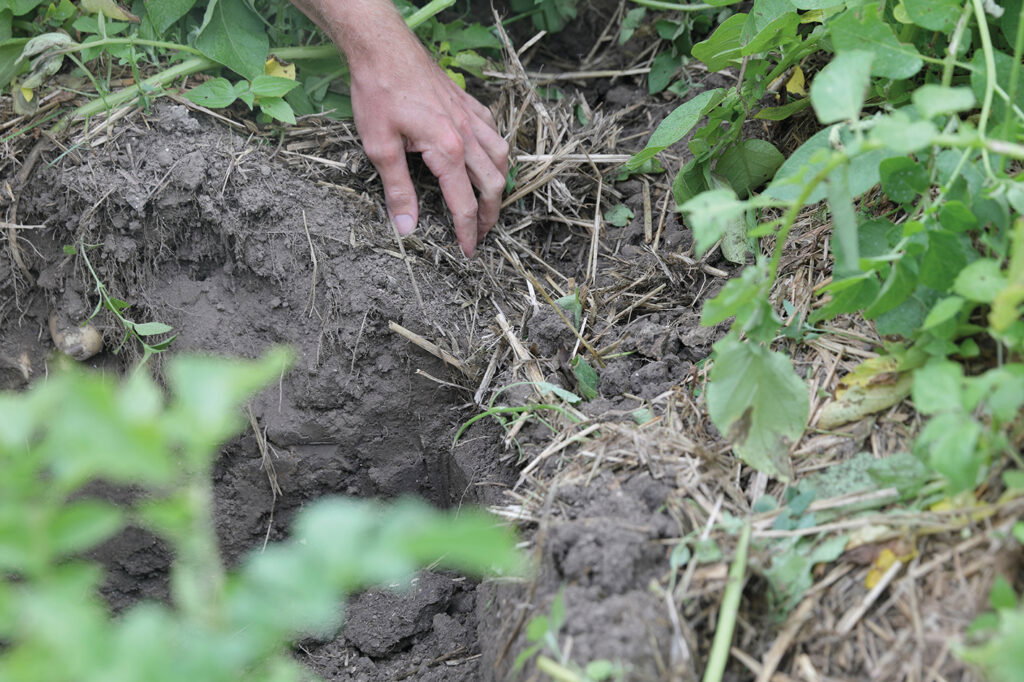
Overall, mulching shows complex effects, changing the below- and aboveground microclimate and ecologies, while also changing the interactions between below- and aboveground processes, often resulting in increases in tuber yield and quality.
In addition to costs, time and labour use, there are more disadvantages to using mulch. Obvious ones are pollution caused by plastic film and the risk of contamination. Improper application techniques can hamper emergence and stem survival. Mulch can cause overheating. The effect of carbon-rich organic mulch (such as straw) on the nutrient balance is not always positive. Mulch can attract rodents and voles that eat potatoes or slugs and insects that damage or infect potato vines. Excess moisture in the mulch can cause stem rot and as stated, enhance blight diseases.
The positive effects of mulch very much depend on the environmental conditions during the growing season. For example, its positive effect on retention of soil moisture depends on the amount of precipitation during crop growth. Nevertheless, overall, mulching dampens the negative effects of climate change on potato production. The ecological impact of mulch is also often uncertain, but while recent papers suggest both negative and positive effects, the net outcome is usually positive.
Mulch can become a strategic tool to reduce the potato crop’s sensitivity to climate change and to some pests and diseases. Reports on multi-annual research and meta-analyses, however, illustrate the delicate balance between negative and positive effects. Deploying mulching requires a thorough cost-benefit analysis, with the outcome of such an analysis depending on (future) weather conditions and cultivar-specific responses to the effects of mulch. ●
Events



©2015 - 2026 Potatoworld | Webdesign and realisation COMMPRO